

MEET THE BROWN ANOLE: SOUTHWEST FLORIDA’S LITTLE BROWN LIZARD
On a warm afternoon in Southwest Florida, it is hard to miss them. A small lizard darts across a driveway, pauses on a garden wall, or races through the mulch beneath a palm. Most commonly it is the Brown Anole (Anolis Sagrei) which has become one of the most familiar reptiles in Florida and one of the state’s most successful introduced species.
Also called the Cuban Brown Anole, this little lizard is native to Cuba, the Bahamas and other Caribbean islands. It was first documented in Florida in the late 1800s, apparently arriving as a stowaway in cargo. It has, since then, spread throughout the Florida peninsula and become especially abundant in human-dominated landscapes.
For residents of Southwest Florida, brown anoles are particularly familiar. They thrive around homes, golf courses, gardens, parking areas, fences and landscaped neighborhoods. Their preference for sunny, disturbed environments makes communities throughout the region ideal habitat. UF/IFAS describes them as particularly common around suburban yards and other human-modified areas.
RECOGNIZING A BROWN ANOLE
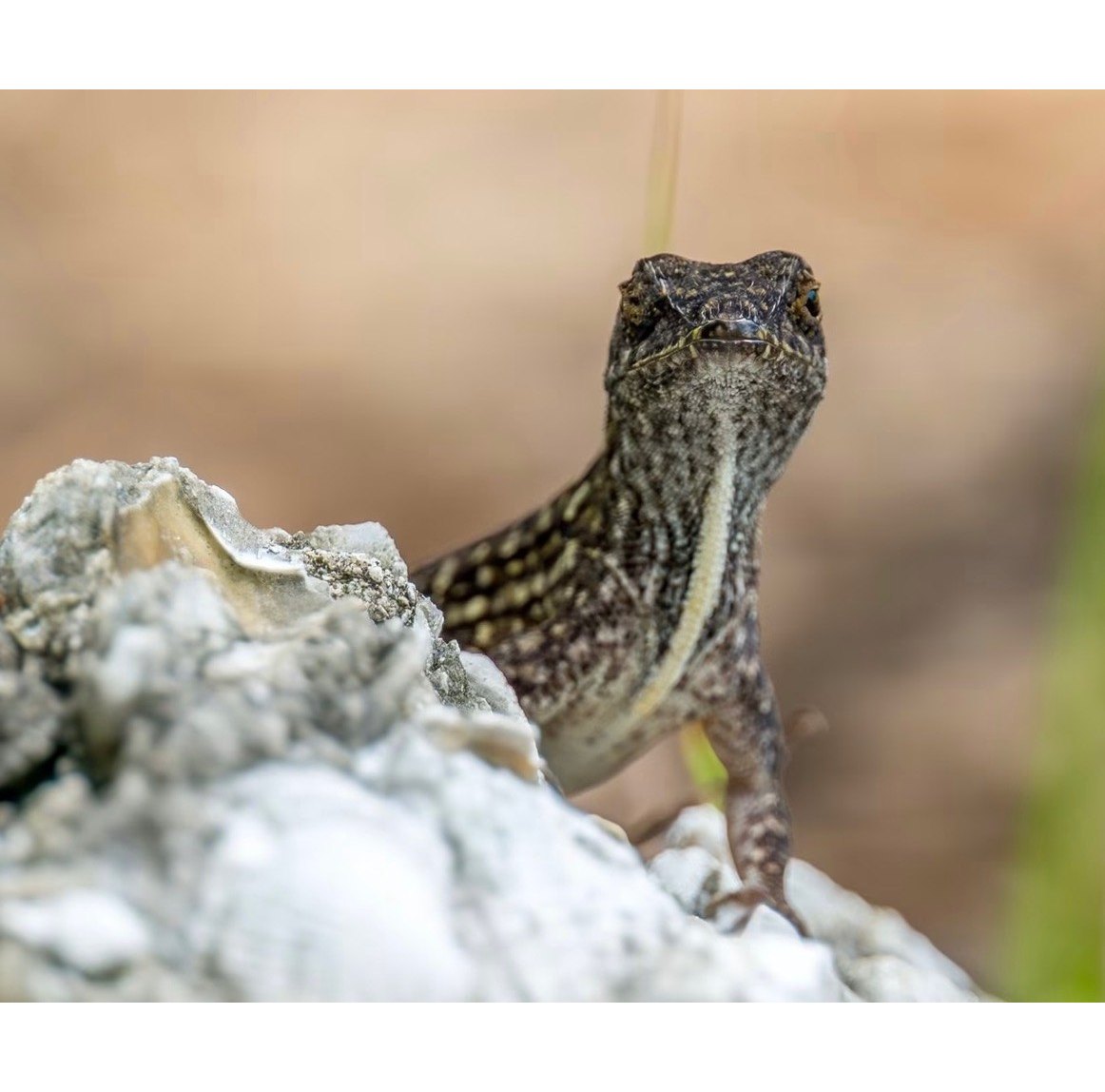
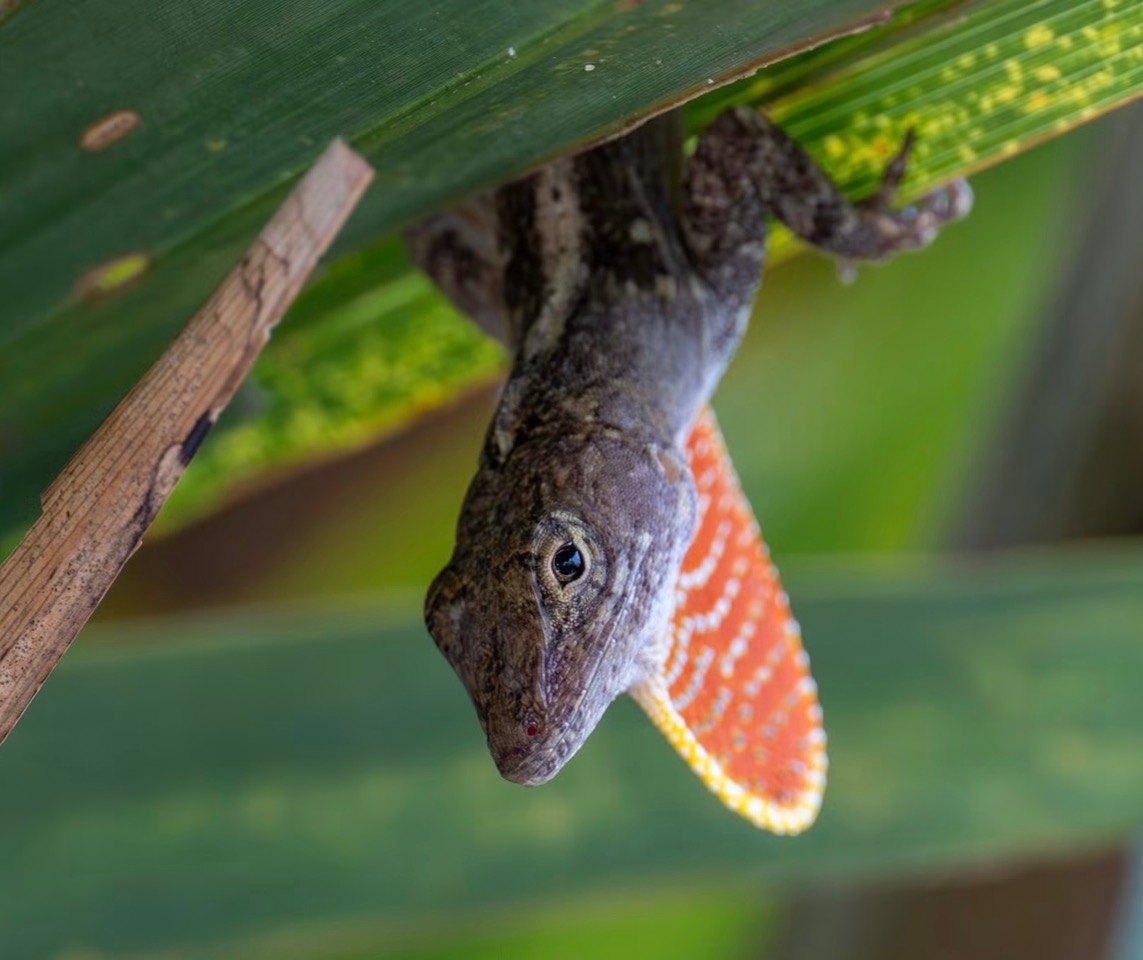
Brown anoles are relatively small, generally reaching about 5 to 9 inches from nose to tail. Their coloration is surprisingly variable. They may appear tan, brown, gray, nearly black or even reddish, often with darker markings, spots or bands.
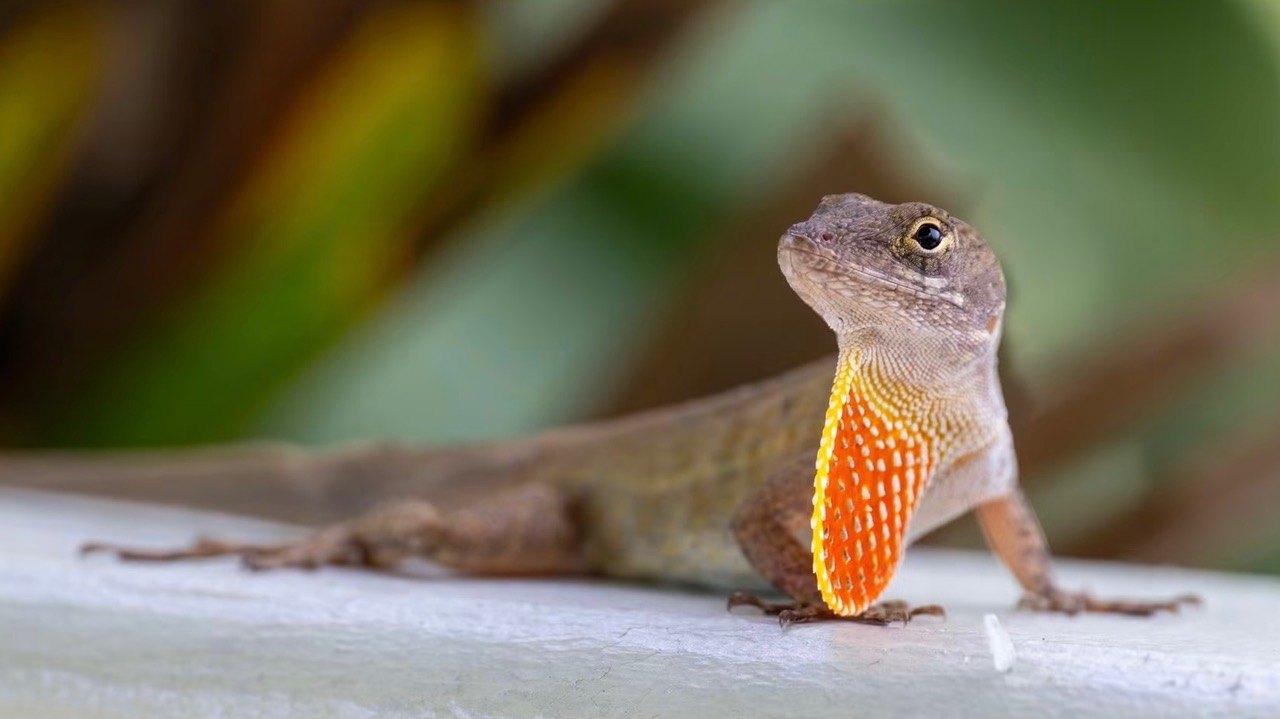
The easiest way to identify an adult male is to watch for its “dewlap”, the flap of skin beneath the throat. When displaying, the male extends a striking orange-red throat fan bordered in yellow. He may combine this display with head-bobbing and push-ups as he advertises his territory or attempts to attract a mate.
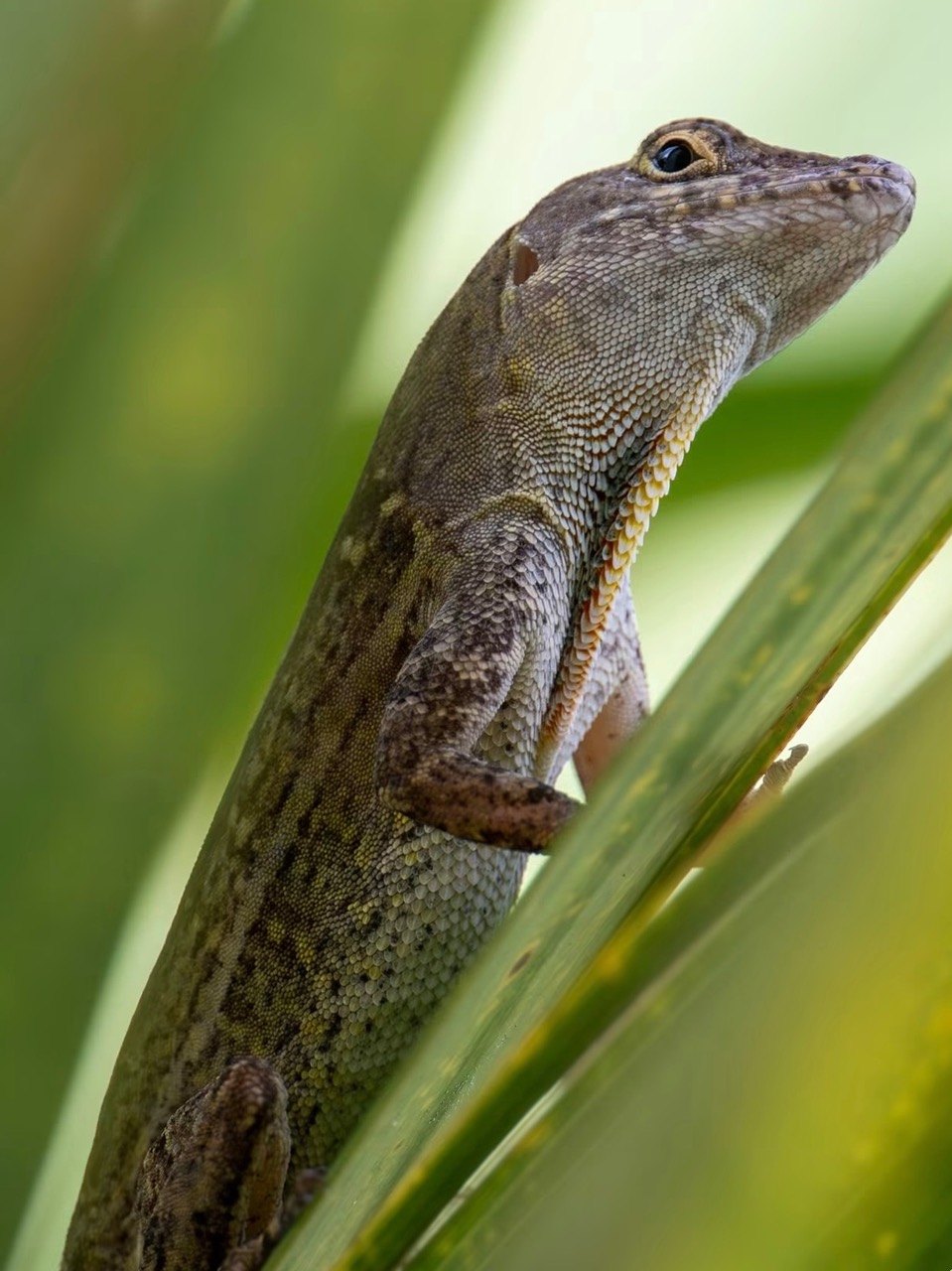
Females and young brown anoles are often more heavily patterned and commonly have a pale stripe running down the middle of the back.
Their flattened toes have expanded adhesive surfaces that make anoles exceptional climbers. Brown Anoles are nevertheless considered a “trunk-ground species”. They frequently spend time on the ground, low vegetation, tree trunks, fences and walls rather than high in the canopy.
AN INSECT HUNTER IN YOUR YARD
Brown anoles are predators, feeding primarily on insects and other small invertebrates. Their menu can include beetles, flies, spiders and other arthropods. They can also consume vegetation and occasionally other small lizards including young green anoles.
That makes the brown anole an interesting resident of the Southwest Florida landscape. Although its introduction has ecological consequences, the lizard itself is not dangerous to people and can provide a useful source of insect control. It also becomes food for birds and other native predators.
WHAT HAS HAPPENED TO THE GREEN ANOLES?
The brown anole’s success has created an interesting relationship with Florida’s native Green Anole (Anolis Carolinensis). Green anoles are sometimes confused with brown anoles because they can also become brown. The important distinction is that a green anole can change between green and brown, while a brown anole DOES NOT turn green. Green anoles also generally have a longer, more pointed snout.
The arrival of brown anoles has changed where green anoles spend their time. Research from the University of Florida found that when the two species coexist, green anoles tend to move higher into vegetation while brown anoles remain closer to the ground. This vertical separation allows the two species to use different portions of the same habitat.
OTHER ANOLES IN FLORIDA
Southwest Florida’s anole story is more complicated than just brown versus green. Florida is home to several introduced anole species, although many are concentrated in South Florida.
The Bark Anole (Anolis distichus), for example, is considerably smaller than the brown anole and has a more mottled appearance. Males have a pale yellowish or greenish dewlap.
The Puerto Rican Crested Anole (Anolis Cristatellus) can resemble a brown anole, but adult males typically have a distinctive jagged crest along the back or tail. It is found primarily in Miami-Dade County.
Florida’s complete anole list is even longer, including the Knight Anole, Cuban Green Anole, Hispaniolan Green Anole, Jamaican Giant Anole and several others. The Florida Museum of Natural History lists these species as nonnative, while the Green Anole remains the state’s only native anole species.
For most Southwest Florida residents, however, the daily encounter is likely to be with one of two familiar characters: the green anole climbing above the garden or the brown anole scurrying beneath it. Together, they provide a fascinating example of how Florida’s rapidly changing landscape has become a meeting place for native wildlife and reptiles introduced from across the Caribbean.