


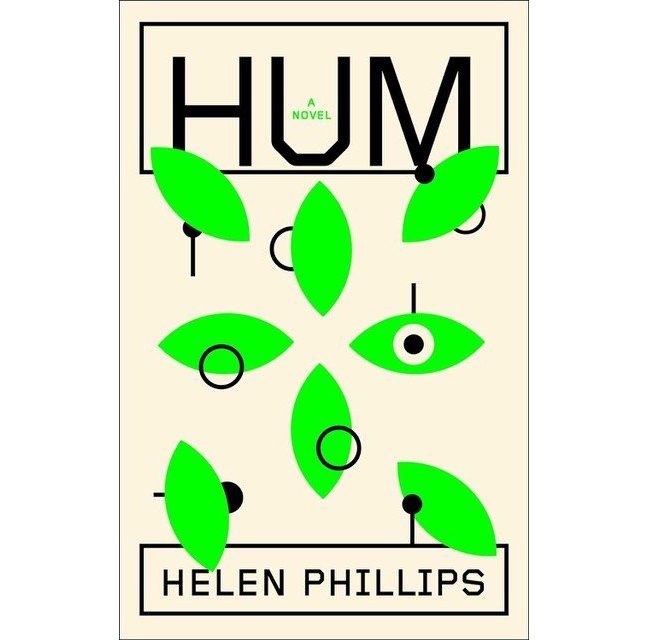
HUM is a thought-provoking novel by Helen Phillips set in the near future where robots called “hums” (as in “humanoid”) constantly monitor everyone and perform jobs previously done by humans. While the novel depicts a dystopian world changed by AI technology, it’s focus is on an enduring human need for love, family, and identity.
The story follows May Webb, a mother of two young children who loses her job after the artificial intelligence she helped develop replaces her. May’s husband Jem has also lost his job as a musician and now relies on doing various service “gigs” to support his family. The narrative starts with a disturbing description of an eye lid surgery performed by a robot. Desperate to support her family and pay outstanding debts, May agrees to undergo an experimental procedure that alters her face so surveillance systems can no longer recognize her.
In this society children always wear their wristband devices called “bunnies” and prefer chatting with the tiny, friendly robots rather than communicating with their parents. May and Jem tend to spend most of their free time inside cozy individual “wooms” that distract and entertain, while constantly offering various products and services identified by AI. On a positive side though, children’s “bunnies” always track their locations and enable May and Jem to know where their children are at any time.
Seeking to temporary escape the family’s dependance on intrusive technology, May uses money she earned from the surgery to take her husband and two young children to the Botanical Garden. One of the few remaining idyllic, natural spaces in their city, the Botanical Garden promises visitors fresh air, clean water, green forests, and “fruits right off the trees.”
What begins as a hopeful family escape quickly becomes a tense exploration of trust, technology, and survival, when children accidentally step through a random door and find themselves in a rundown, seedy, dirty area of the city.
Phillips excels at creating a future that sounds somewhat familiar. Rather than relying on describing dramatic scientific inventions, she builds her story through realistic extensions of today’s world around us: AI replacing workers, personalized advertising, invasive surveillance, human-driven climate change, and environmental destruction. These elements make the novel feel less like fantasy and more like a warning about the direction modern society could take.
Although Hum raises complex questions about artificial intelligence and technological progress, the heart of the story is May’s fierce determination to protect her children. Phillips portrays motherhood with honesty and vulnerability, showing how parental love persists even in a world where human relationships are increasingly mediated by technology. The emotional dilemma between preserving the family and adapting to technological change builds captivating tension to the story.
Phillips creates a dramatic story without being overly descriptive. By creating an atmosphere of quiet anxiety that intensifies steadily throughout the novel, she enables readers to recognize emotional and philosophical questions alongside the suspense. In a recent interview, Phillips indicated that rather than provide a definitive ending, she was compelled to leave it somewhat ambiguous, to encourage readers to consider various potential outcomes.
Overall, Hum is an intelligent, beautifully written novel that explores timely issues surrounding artificial intelligence, privacy, climate change, and what it means to remain human in an increasingly automated world. The author reminds readers that even as technology evolves, empathy, love, and human connection remain our greatest strengths.