


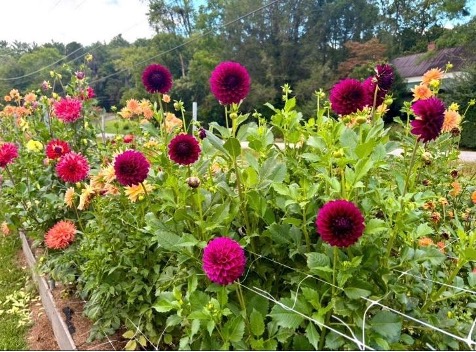

The pleasant fragrance of freshly cut dahlias.
The taste of a fine, cool, crisp wine.
Watching a warm sunset melt into the horizon.
How often do we truly slow down long enough to notice and appreciate the beautiful things happening right in front of us?
It is easy to place our joy on hold, waiting for some future moment or milestone to bring us happiness. Yet savoring is one of the most meaningful pathways to joy.
In a recent “Harmonize with Happiness ™t” workshop activity, the choices were simple: an orange slice, a dark chocolate-covered almond, or a mini sugar bomb tomato. Although I had never used this exercise before, we slowly placed each item into our mouths and let it rest on our tongues for a brief moment before biting down. We paid attention to the texture, the aroma, and the taste, allowing ourselves to fully experience each bite with all of our senses. Very quickly, people began to say things like, “I have never enjoyed eating something quite like this before,” and “I usually rush while I eat.”
Together, we practiced mindful eating and savored each bite. What might have otherwise been an ordinary experience became something surprisingly rich and meaningful. In slowing down, we transformed a simple moment into an extraordinary one.
In The How of Happiness, Dr. Sonja Lyubomirsky explains that we often struggle to live in the present because we believe the most important or meaningful parts of life are still waiting for us somewhere in the future. She suggests that some of the people who understand savoring most deeply are those who have endured painful life circumstances, such as a brush with mortality or a major scare. Experiences like these can awaken a deep awareness of life’s fragility and beauty, leading people to live each day with more gratitude and appreciation. They begin to savor life more fully, finding joy even in its simplest moments.
But it should not take a traumatic event to teach us how to slow down and notice the beauty around us. Another powerful way to savor life is by revisiting meaningful memories, writing about them, or sharing them with someone else. When we return to a joyful experience, we often relive it in a way that allows those emotions to rise again.
One memory I return to often is a trip I took to Hawaii with my mom. As we drove along the coastline, the sky stretched wide and blue above us. The sun’s warm rays kissed my shoulders, and the crisp air moved through my hair. Looking out at the ocean, I saw large rock formations rising from the sea. Looking inland, I was surrounded by tropical trees and lush green foliage, while snowcapped mountains stood in the distance. I was completely in awe of the beauty around me.
That experience left a deep imprint on my heart, and each time I share it, I get to savor it all over again. The joy returns, and the memory feels alive once more. Being able to call upon a meaningful moment from the past can bring comfort, perspective, and pleasure, especially during difficult times.
Whether we are savoring a treasured memory or the moment unfolding before us right now, savoring is a mindfulness practice that can become a daily habit. It has the power to transform our lives by teaching us to pause, notice, and fully receive the good that is already here. As we learn to savor, life becomes more than a series of good moments. It becomes the practice of truly noticing them with every sense of our being