

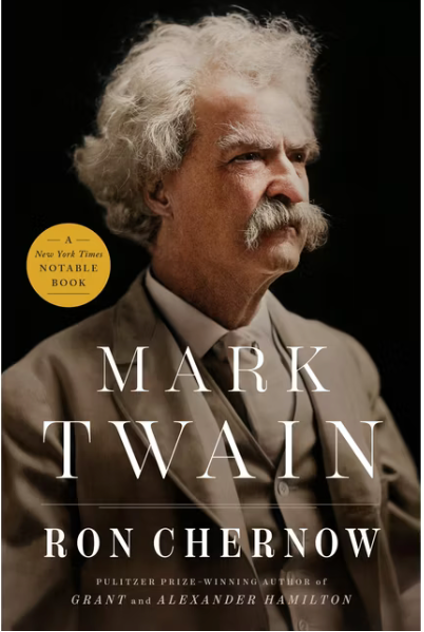
MARK TWAIN BY RON CHERNOW
Those who are familiar with the Pulitzer Prize winning author Ron Chernow’s previous biographies Alexander Hamilton, Ulysses S. Grant and John D. Rockefeller are aware of the detail the author imparts to his biographies.
Chernow will not disappoint you with his thousand page plus narrative of Mark Twain. This is not for the light reader but it is an excellent read for those who have grown up reading The Adventures of Tom Sawyer and Huckleberry Finn and who wish to learn more about Samuel Langhorne Clemens’ life. Twain is considered one of the greatest and most influential American authors and humorists.
The book starts out with Samuel Langhorne Clemens’ (Mark Twain’s) early family life encompassing three decades. It is incredibly well told and will engage the reader. Twain’s guidance from his brother Orion, the loss of his brother Henry, the struggles of his father in finances and the strength of his mother are revealed.
Early fascination with the riverboat eventually leads to Clemens becoming a pilot of a riverboat on the Mississippi River. Aside from his wild and mischievous boyhood before the Civil War he saw the life of a pilot as free from any servitude on the land. This search for truth and freedom would form the defining quest of his life.
Chernow devotes two hundred pages to Twain’s early life that I found most enjoyable, but I must admit I am partial to his life that molded his early story telling.
During Clemens’ young adult life he courted and married Livy Langdon of a well-to-do upbringing, allowing him to focus on his passion for writing. Their three daughters with their differences in personalities as well as the loss of his favorite daughter led to future emotional issues for both parents.
Livy was not only his wife; she was his organizer, proofreader, stabilizer of his sometimes overreaction to political, racial and Semitic persecution of which his personal biases kept him from making enemies. He was an advisor to Teddy Roosevelt on race relations, held friendships with Harriet Beecher Stowe, and Booker T. Washington. Additionally he championed the cause against lynching with his 1901 essay “The United States of Lyncherdom.”
After the passing of Lizzy, Clemens hired a well-educated attractive lady named Isabel Lyon to take over the details of his late wife in business, organization, motherly duties and reading his writing prior to publication. Though he was never romantically involved with Isabel, she lived in their house and supervised his daughters and a member of the family. She believed “Never, never on sea or shore of spiritual or terrestrial being could there be a man to equal Mr. Clemens” in detailing the complexities of such an arrangement.
More than half of the book’s text is devoted to chronicling Clemens’ lack of business judgments, his becoming involved with people who would take advantage of his naivety and his overspending on personal items that would put him debt.
The latter part of the Chernow’s biography describes Twain’s lack of filter in his writing concerning issues and friendships. He developed a proclivity to young girls that he called his Angelfish which numbered twelve, ages ten to sixteen years. He called them his surrogate granddaughters.
Chernow embraces his subject’s complexity, including his passion for writing and thoughts that are quite detailed. Unlike his other books you may learn a great deal about such an illustrious man but also may need a dram of whiskey to finish.