


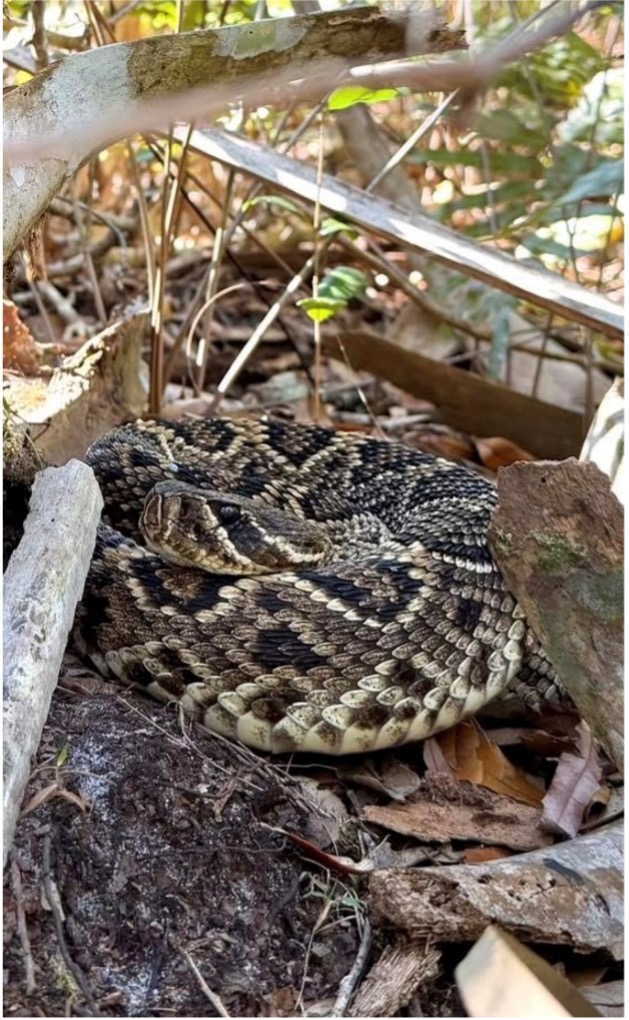
Southwest Florida is a biodiversity hotspot and home to a wonderfully amazing collection of wildlife. Living in Grandezza means we are really lucky to share this area with large iconic mammals, reptiles and marine life, and such an absurd array of birds that it’s impossible to count them all. Wading birds, shore birds, songbirds, raptors, and so many birds of prey that the list seems endless. I have been lucky enough in the 19 years of living in Florida to capture a few decent photos of some of its finest and I’ll feature them here in Wild Grandezza.
TODAY’S FEATURE: THE EASTERN DIAMOND BACK RATTLESNAKE
I went left of the cart path on Grandezza’s hole number six looking for a wayward tee shot and I happened upon this fellow. He was resting comfortably near the base of one of the cabbage palm trees. I noticed him from about 10 feet away and he was not at all bothered by my presence. I would guess he had just had a good meal because like most snakes he was not interested in human contact and seemed pleased that I decided to slowly back away. I’ve learned from multiple encounters with venomous snakes that they’re a lot like insurance companies… you leave them alone; they leave you alone. That’s how it works!
OVERVIEW OF THE EASTERN DIAMONDBACK
Eastern Diamondback Rattlesnakes are one of six venomous snake species found in Florida out of the approximately 20 species in the United States. They are the largest venomous snake in North America. They are generally not aggressive and will avoid human contact if given a chance to do so. They will use their distinctive rattle as a warning to indicate that they do not want to bite so it is unquestionably best to slowly back away from the source of that sound. Most snake bites happen when people try to handle or unnecessarily kill the snake. Their bite will deliver a hemotoxic venom that will severely damage human tissue, disrupt blood clotting and if untreated could potentially cause death.
Insurance: You leave them alone; they leave you alone!
Diamondbacks favor places like dry pine flatwoods, Palmetto thickets, scrubby coastal areas, edges of golf courses (Oh Really?), and undeveloped lots. They are especially common in regions like the Everglades and Big Cypress National Preserve where their natural habits remain largely undisturbed, but they can turn up anywhere with good cover and enough prey.
Around Grandezza this means you must pay close attention to where you are walking, especially near the golf course (palmetto thickets, water based heavy grasses) or anywhere where we have natural or “preserve” type landscapes. If you see rabbits or squirrels, then it is likely that predators like the Eastern Diamondback also are nearby.
Diamondbacks typically range from three to five feet but can sometimes exceed six feet in length. They are heavy-bodied with distinctive dark diamond patterns and a thick tail with a prominent rattle. Their camouflage blends nearly perfectly with pine needles and sand so it’s likely they will see you long before you see them.
I’M JUST MISUNDERSTOOD
The Eastern Diamondback, in SW Florida, is a very important and often misunderstood part of the ecosystem. For Florida, the Eastern Diamondback is less a “dangerous snake” than a keystone mid-to-top or APEX predator helping maintain balance in upland ecosystems. It is one of Florida’s most important native predators, and its role in the ecosystem goes well beyond being just another snake. In Florida’s pine flatwoods, scrub, coastal hammocks, and prairie habitats, it helps keep food webs balanced in several ways.
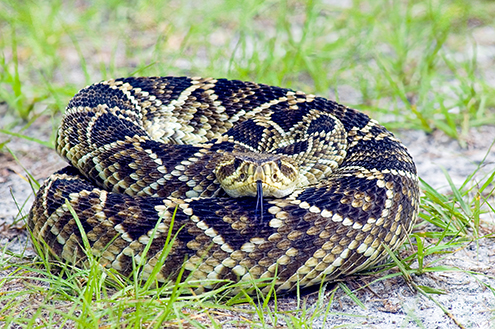
1. Rodent population control – They eat small mammals—rats, mice, rabbits, squirrels, and similar prey.
2. Disease ecology – Because rodents can carry ticks, fleas, and pathogens, predators like diamondbacks indirectly influence disease dynamics.
3. They are both predator and prey – Young diamondbacks are prey for birds such as hawks, eagles, and wading birds, as well as mammals like raccoons and foxes.
4. Indicator of healthy longleaf pine ecosystems – The presence of diamondbacks often indicates relatively healthy habitat with good prey diversity, appropriate ground cover, natural fire cycles, and a connected upland habitat supporting other species like Gopher Tortoises, Red-cockaded Woodpeckers, and many native pollinators.
5. Connection to gopher tortoise burrows – Diamondbacks frequently shelter in burrows created by the Gopher Tortoise. Those burrows are used by hundreds of other species, so protecting tortoise habitat often benefits diamondbacks and vice versa making them a key part of a larger “burrow community.”
6. Maintaining natural selection pressures – As ambush predators, diamondbacks influence prey behavior—where rodents forage, when they move, and how they use cover. This “landscape of fear” effect can shape plant regeneration and small-animal behavior across an ecosystem.
THREATENED IN FLORIDA
Habitat loss, road mortality, and intentional killing have significantly reduced populations in parts of the state. Eastern Diamondbacks reproduce relatively slowly so local populations can take years to recover and in some areas they have likely disappeared forever.
So, in other words … if you think “The only good snake is a dead snake!” — Please don’t be that guy. The Eastern Diamondback is an extremely important part of Florida’s ecosystem and biodiversity. It prefers that you simply leave it alone and it will go on about its business of being nature’s pest control.