

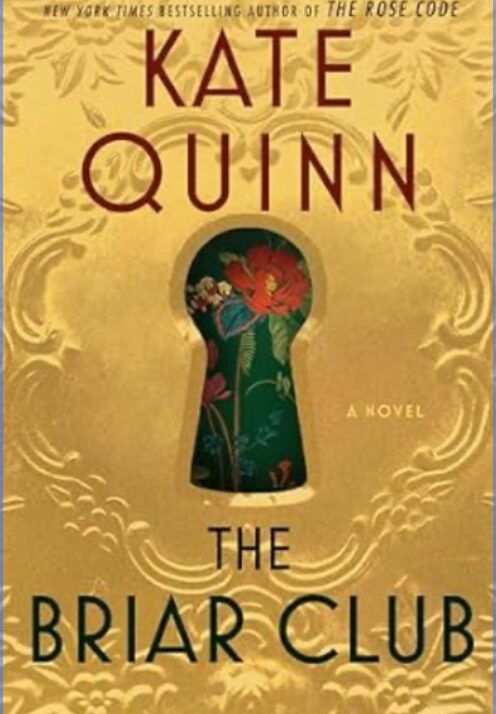
Kate Quinn’s The Briar Club is a satisfying blend of mystery, oddball friendship, and historical detail that transports readers to a 1950s Washington D.C. boarding house where a group of female lodgers discover that their differences can become their greatest strength. The novel certainly has its quirks: The Briarwood House itself is a “character” and narrates about its comings and goings. The heart of the story lies in Grace March and her fellow renters—Nora, Fliss, Bea, Claire and Reka. Each of the characters is battling her own demons from the past amid the larger spy-thriller plot that surrounds them.
Grace March arrives at Mrs. Nilsson’s Briarwood House as the mysterious widow in the attic room, and she becomes the gravitational center of the novel. She’s enigmatic and warm at the same time, the kind of person who draws others into her orbit without seeming to try. Continually flaunting the landlady’s stringent, mean rules, Grace and the other boarders thankfully become parental substitutes to the Nilsson children, Pete and Lina. What makes Grace compelling isn’t just her eventual revelation of her mysterious background, but how she uses her Thursday night attic room dinner parties as genuine acts of connection before everything falls apart.
Nora Walsh is where the book finds its emotional core. A smart, principled secretary at the National Archives and a policeman’s daughter, Nora is a young woman trapped between her family’s expectations and her affair with a mobster named Xavier. She represents the struggle for female independence that hums beneath the 1950s domesticity that the era pretended was universal. She wrestles with her ideals, law, loyalty, and hopes.
Fliss Orton, a perky English mother struggling with postpartum depression and an absent wartime-serving husband, offers a strikingly honest portrait of motherhood and marriage. Quinn doesn’t romanticize Fliss’s situation; instead, she shows the cracks behind the character’s perfect facade—the exhaustion, the resentment, and societal pressures.
Bea Verretti, a former baseball star, carries the weight of unrealized potential. As an athlete whose career ended when women’s professional baseball was curtailed by World War II, she represents a particular postwar struggle: women being quietly returned to their “proper place” after tasting something more. Quinn uses Bea effectively to explore how quickly America erased the contributions women made during wartime, sending female athletes back to domesticity the moment men returned home.
Reka Muller, an older, gruff Hungarian artist and refugee works at the local library. Now living in reduced circumstances, she brings with her a strong perspective on displacement, age, and her Holocaust immigrant experience.
Claire Hallett is a sharp-tongued, cynical secretary who works for Maine’s Senator Margaret Chase Smith on Capitol Hill, and she also has a couple of questionable secondary jobs and habits. She rounds out this circle of women, adding another layer to the friendship dynamic and the novel’s exploration of how McCarthy-era Red Scare anti-communist paranoia infiltrates even intimate relationships. The women must navigate which secrets are safe to share when informants and suspicion lurk everywhere.
The real strength of The Briar Club is Quinn’s depth of the individual stories and how the women’s friendships and hopes are developed against the backdrop of WWII and the Korean War. The Thursday night suppers feel lived-in and genuine, a refuge from the Cold War paranoia that defines their era. Quinn uses historical moments such as the dissolution of women’s professional baseball, the terror of McCarthyism, and the enforced gender expectations of the 1950s facing women not as a mere backdrop but as the very pressure that forces these women together.
While The Briar Club is chock full of issues, where it stumbles a bit is in its structure. Initially I was confused because Quinn frames the story with the mystery of a murder investigation, then jumps between timelines and perspectives. The resolution also feels somewhat neat, maybe too tidy for the messy complications these characters have endured.
This reader feels like she got to know each of the main characters well and The Briar Club lingers. The novel is a slow burn that trusts readers to care about these characters and their era enough to stick around, and I’m glad I did. Quinn weaves a story of women creating their own chosen-found-family while navigating a nation afraid of its own shadow in an age of McCarthyism and rigid social expectations. A book club friend listened to this book in audio format and raved about the reader’s differentiation of the characters, although I read it in written form. Whichever format you prefer, I’m pleased to recommend this novel to you, Grandezza Gazzette readers.