

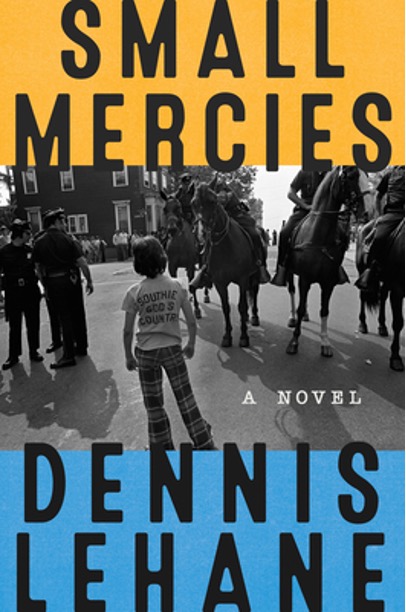
Best-selling author Dennis Lehane—known for Mystic River, Gone, Baby, Gone, and Shutter Island—takes us to 1974 South Boston in a masterpiece rivaling his earlier works. In Small Mercies, the Southie community faces the explosive issue of busing and integration aimed at equalizing the playing field in schools. Beyond the suffocating summer heatwave, this gripping novel sizzles with graphic violence, racism, pervasive profanity, and crime.
Lehane brilliantly creates a tough-as-nails female protagonist in Mary Pat Fennessy. Mary Pat has spent her entire life scraping by in a public housing project surrounded by her “own kind.” Like the rest of her Commonwealth community, she is set in her ways and beliefs. Under the ostensible protection of the Butler mob that controls the area, no one welcomes the prospect of Black students being bused into their close-knit Southie neighborhood while white students are bused out to Roxbury. Why should they mix with people of a different race? Mary Pat and her neighbors simply want steady paychecks, food on the table, and safe streets. Against this impending crisis, Mary Pat is thrust into desperate action when her sixteen-year-old daughter Jules fails to return home one evening after hanging out with friends. That same night, a young Black man named Auggie Williamson is found dead at Columbia Station, allegedly struck by a train. Could there be a connection between these two events?
Mary Pat will stop at nothing to find her daughter. Having already lost her son Noel, a Vietnam veteran who died from a heroin overdose after returning home, she cannot bear to lose another child. She’s also alone: her husband Ken left her and, in her bitter view, has become “hoity-toity” working in the mailroom at Harvard’s Memorial Hall, reading and quoting highfalutin books. She is desperate.
With hope in each step and at every door she knocks on, Mary Pat scours the neighborhood for Jules. She tracks down Jules’s friends, who assure her Jules was alive when they last saw her at 12:45 AM, though they don’t know where she went after they headed home to sleep off their night of partying. The desperate mother questions unsavory characters around town, many employed by powerful mob boss Marty Butler. Their evasive answers suggest they cannot, or, will not help solve the mystery. They dismissively hint that perhaps Jules ran away to Florida and warn Mary Pat to stop searching. She even talks to Michael “Bobby” Coyne, a policeman investigating Auggie Williamson’s death, fully aware that being seen cooperating with, or even talking to a cop is considered a betrayal by Southie residents. Butler’s associates don’t take kindly to Mary Pat’s interference, but the raging, unyielding mother defies the neighborhood power structure and refuses to back down.
Small Mercies is an unforgettable story of revenge illuminated by brutal neighborhood control, criminality, and cover-ups. It works as an archetypal tale of good versus evil. Lehane has crafted a perfectly complex protagonist—simultaneously hateful and heroic—who sees her neighborhood for what it truly is, while examining culpability for indoctrinated racism. This is a fabulous read that tugs at your heart and questions the concepts of neighborhood, family, and values.
I can’t help thinking this novel would make an amazing film in the hands of directors like Martin Scorsese or Quentin Tarantino.