
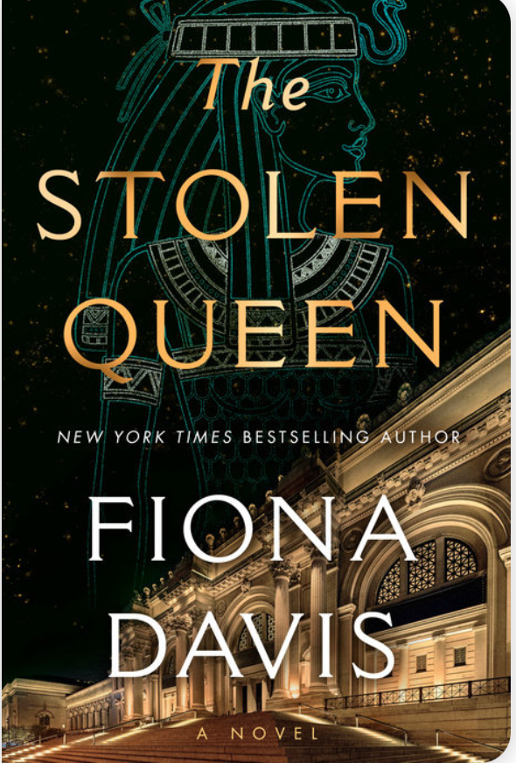
Fiona Davis has once again masterfully blended history and fiction together in her latest novel The Stolen Queen. Known for her dual-timeline narratives set against iconic backdrops, Davis takes readers on a journey that weaves past and present with meticulous research and compelling storytelling.
The Stolen Queen follows two women separated in age by forty years. As an anthropology student in 1936, Charlotte Cross is part of an archaeological dig in Egypt’s Valley of the Kings when she unearths a significant discovery in a maze of burial tunnels. Charlotte had been studying the reign of an ancient Egyptian named Hathorkare who was married to the pharaoh Saukemet I, and who, upon his death stole the throne from her stepson when she named herself pharaoh. Although this fifth pharaoh of the Eighteenth Dynasty of ancient Egypt ruled for twenty years Egyptologists dismissed and disdained Hathorkare’s accomplishments to culture and government as unimportant. Also, according to ancient Egyptian legend a curse is attached to anyone who disturbs or removes anything from Hathorkare’s royal entombed mummy. Even years later Charlotte wonders if there is truth to the curse. Due to an unforeseen tragedy she had been forced to cut short her stay in Egypt in 1936. Now, years later, she leads a quiet life as an associate curator and leading specialist of Egyptian art collections at the Metropolitan Museum of Art in New York City and is working on preparation of the upcoming King Tut exhibit at the museum.
In New York City, 1978, Annie Jenkins is a nineteen-year-old woman who secures a job at the Met as an assistant to the demanding Diana Vreeland, former editor of Vogue and Harper’s Bazaar, who is designing the event of the year, the famous Met Costume Gala.
When a long-lost Broad Collar belonging to Hathorkare emerges with mysterious provenance in the museum’s collection, the paths between Charlotte and Annie converge. Intrigue further develops, when, on the night of the famed gala a different precious artifact, the Cerulean Queen statue, goes missing. The two women, unlikely matched, set off to search for the missing art as they travel to Egypt, a place that Charlotte never expected to see again because of her past experiences there.
Fiona Davis excels at creating atmospherically rich settings, from the archaeological digs of 1930s Egypt to the bustling halls of the Met. Many of her descriptions of the museum’s holdings resonated with this fan of the Met. Especially interesting is Davis’ attention to historical details such as the Egyptian mummification process, burial customs, the depictions of pharaohs and the rights of women. Furthermore, the issues of the selling of antiquities on the black market and the deaccession and repatriation of art, i.e. sending everything back to its country of origin, are considered.
The characters are well-developed, particularly the journey of Charlotte from eager archeologist to respected specialist, and Annie’s growth as she navigates the challenges of the museum world. Their parallel stories, though separated by time, reflect complementary themes of female determination in historically male-dominated fields.
The Stolen Queen stands as another worthy addition to Davis’s bibliography that will appeal to fans of historical fiction, art history enthusiasts, and anyone who enjoys a well-crafted mystery spanning generations. I’m pleased to recommend this novel to you, Grandezza readers.